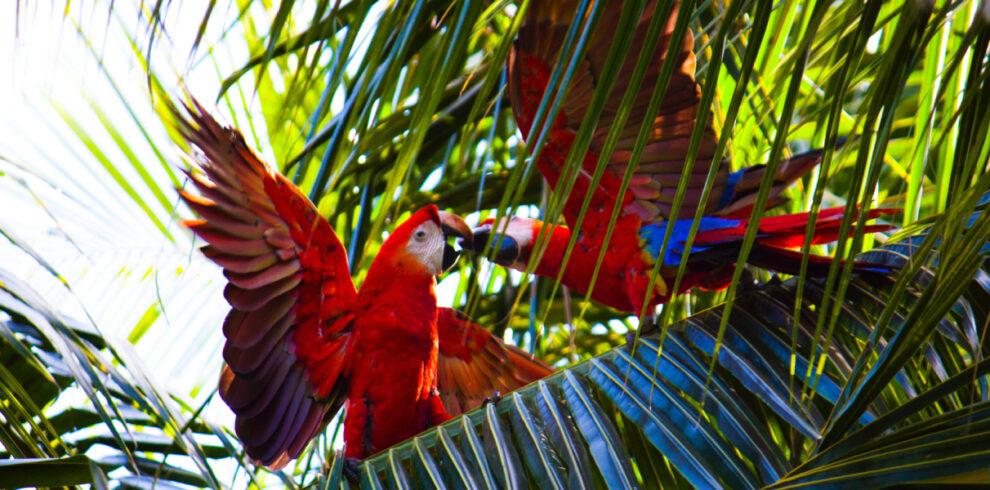
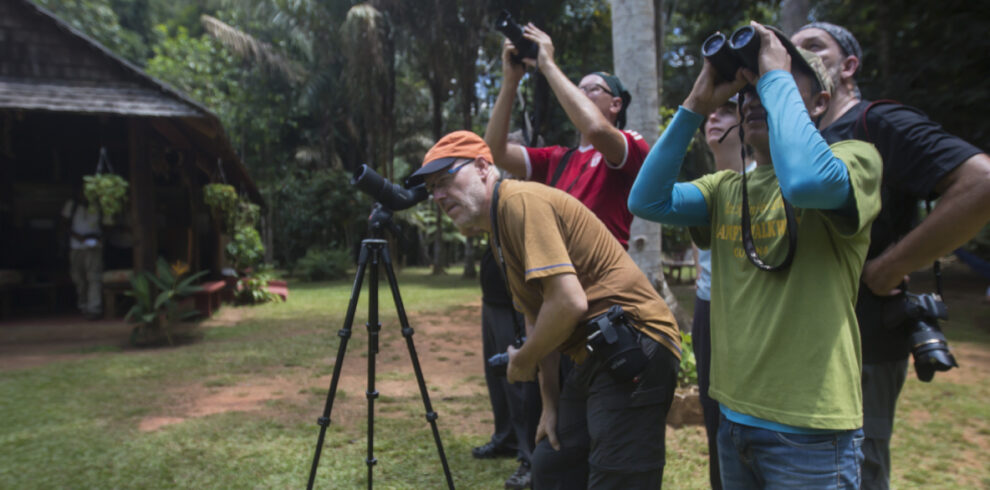
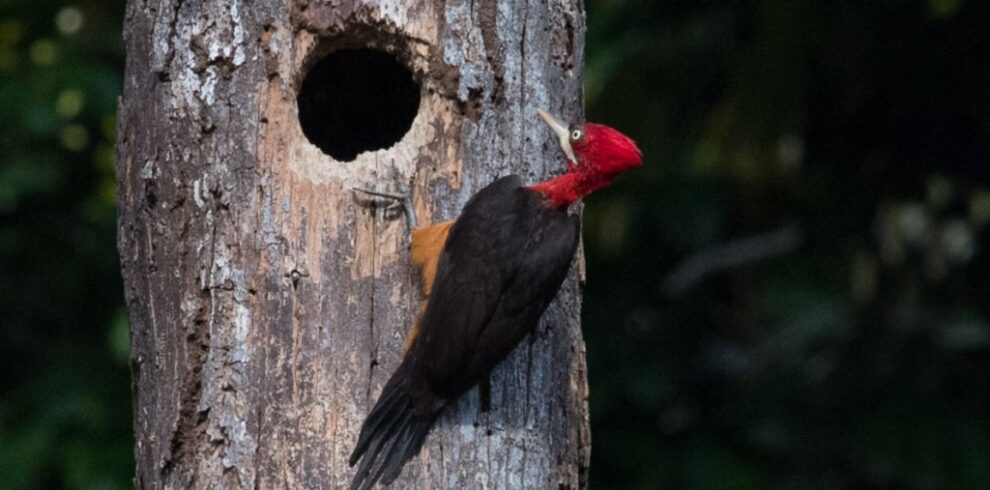
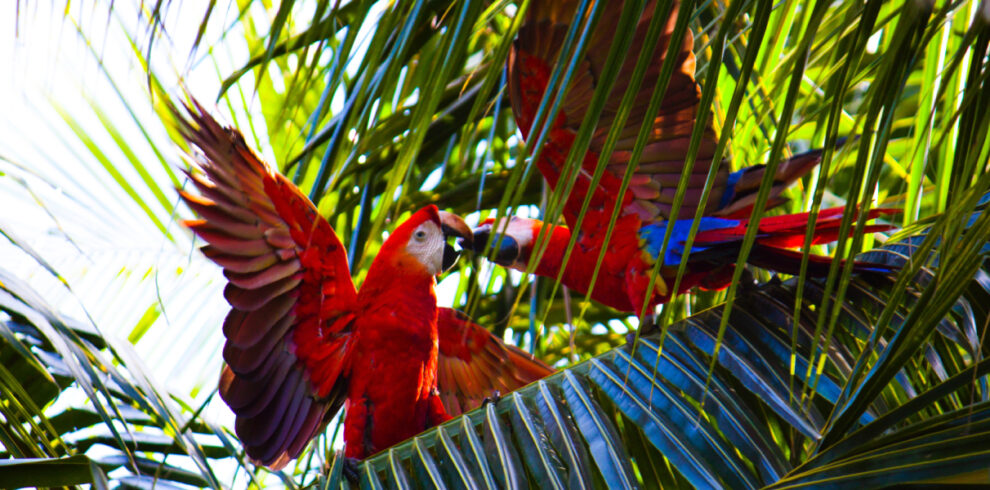
"The quality of guiding was exceptional – particularly for the birds, I’ve got a long list! I wondered whether with tourism being relatively new here how extensive the guide’s knowledge would be, but they couldn’t have been better."–Richard Hawkins, UK

"My main reason to come here was to spend as much time as possible watching wildlife in rainforest, and the trip certainly scored highly here."–RH, London
"Luxury is wasted on me, so that was what pleased me here – you get a real forest experience rather than being packaged up. The food is excellent and the accommodation is just how I like it – comfortable but without too many frills."–Dick H, Europe
"Enjoyed watching a snake eat a frog.. AMAZING TRIP!!! Arawana and Peacock Bass fishing at Rewa from a dugout – unbeatable."–January visitor to Rock View Lodge

Why would I want to travel to Guyana?

Few bother — or dare — to venture into the northwest corner of South America. When told you’re going to Guyana, even your best-traveled friends may offer quizzical stares or uncertain mutterings about the risks associated with “that part of Africa.” But travellers who want to leave the tourist circuit far behind in search of genuine, personal, eye-popping adventure are amply rewarded for their efforts to set foot in this remarkable, lost land.

Guyana has preserved the vast majority of its rainforest in pristine form, replete with all the creatures, big and small, who call it home. This presents an opportunity for first-hand exploration found in few other places on Earth. No touts; no tour bus traffic jams; even postcards and souvenirs are in short supply. When you visit Guyana, you encounter something that’s hard to find these days: a magnificent, untrammeled place.

As South America’s only English-speaking country, Guyana also offers something less dramatic but equally valuable to the curious traveller: opportunities to engage directly with the people. Interior Guyana’s small and dispersed Amerindian population is warm and welcoming, eager to share its traditional knowledge of the rainforest and its rich treasures.The spirit of community in Guyana is strong and unmistakably evident at every turn.

What is the benefit of traveling with Wilderness Explorers?
Wilderness Explorers is Guyana's premier tour operator... and that's not just marketing fluff. For nearly 20 years, we've been working with local and national leaders to build the country's tourism sector from the ground up. Not from the sidelines or behind a desk, but on the ground. In the jungle. On the boats. Getting our feet dirty and seeing everything first-hand. Tourism isn't our business - it's our life. Our handcrafted itineraries prove it.

Our partners in the field aren't just suppliers in the traditional sense: we are deeply involved with the development of the lodges, tours, training programs, and attractions that draw adventurous souls to this part of the world. Back in 1999 Wilderness Explorers was one of the first tour operators to embrace the now-fashionable idea of community tourism, partnering with the Makushi village of Surama to provide marketing and administrative support for the country's first indigenously-operated ecolodge. These days we continue to work with individual lodges and regional consortiums of communities with tourism programs or aspirations. Hand-in-hand we are building this important sector of Guyana's economy together. (Check out our Community page to learn more.)

We know that local tour companies are increasingly looked upon as unnecessary middlemen in a world where the internet connects everyone with marvelous ease. Alas, Guyana is one of those places where having a competent, full-time advocate working for you locally really pays off. Most of Guyana's lodges lack reliable internet, there are no phones in the interior, too few people visit for there to be a well-worn 'circuit,' and the remote nature of Guyana's attractions simply don't lend themselves to modern administrative efficiencies. This is still a world where VHF radios and hand-carried notes are part of daily business. Bottom line: we have the tools, experience, insider knowledge, and personal familiarity to vastly simplify your trip planning process.

Background


Originally a Dutch colony in the 17th century, by 1815 Guyana had become a British possession. The abolition of slavery led to black settlement of urban areas and the importation of indentured servants from India to work the sugar plantations. This ethnocultural divide has persisted and has led to turbulent politics. Guyana achieved independence from the UK in 1966, and since then it has been ruled mostly by socialist-oriented governments. In 1992, Cheddi Jagan was elected president in what is considered the country's first free and fair election since independence. After his death five years later, his wife, Janet Jagan, became president but resigned in 1999 due to poor health. Her successor, Bharrat Jagdeo, was reelected in 2001 and again in 2006. Donald Ramotar was elected president in 2011.

Country name - Cooperative Republic of Guyana

Government type - republic

Capital - Georgetown

Geographic coordinates - 6 48 N, 58 09 W

Time zone - UTC-4 (1 hour ahead of Washington, DC during Standard Time)

Administrative divisions - Barima-Waini, Cuyuni-Mazaruni, Demerara-Mahaica, East Berbice-Corentyne, Essequibo Islands-West Demerara, Mahaica-Berbice, Pomeroon-Supenaam, Potaro-Siparuni, Upper Demerara-Berbice, Upper Takutu-Upper Essequibo

Independence - 26 May 1966 (from the UK)

National holiday - Republic Day, 23 February (1970)

Constitution - 6 October 1980

Legal system - Common law system, based on the English model, with some Roman-Dutch civil law influence

Suffrage - 18 years of age, universal

Executive branch - Chief of state: President Donald Ramotar (since 03 December 2011); head of government: Prime Minister Samuel Hinds (since October 1992, except for a period as chief of state after the death of President Cheddi Jagan on 6 March 1997)

Cabinet - Cabinet of Ministers appointed by the president, responsible to the legislature.

Elections - President elected by popular vote as leader of a party list in parliamentary elections, which must be held at least every five years (no term limits); prime minister appointed by the president

Legislative branch - unicameral National Assembly with 65 seats with 5-year terms

Elections - last held on 28 November 2011 (next to be held by November 2016)

Judicial branch - Supreme Court of Judicature, consisting of the High Court and the Court of Appeal, with right of final appeal to the Caribbean Court of Justice (CCJ)

Flag - green, with a red isosceles triangle (based on the hoist side) superimposed on a long, yellow arrowhead; there is a narrow, black border between the red and yellow, and a narrow, white border between the yellow and the green; green represents forest and foliage; yellow stands for mineral resources and a bright future; white symbolizes Guyana's rivers; red signifies zeal and the sacrifice of the people; black indicates perseverance

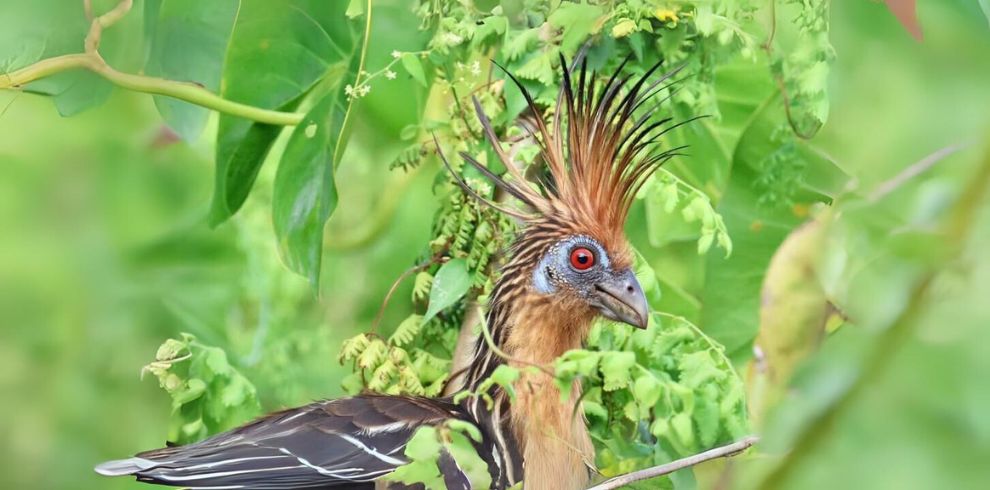
National symbols - Canje pheasant (hoatzin); jaguar

National anthem - "Dear Land of Guyana, of Rivers and Plains";lyrics/music: Archibald Leonard LUKERL/Robert Cyril Gladstone POTTER (note: adopted 1966

Geography

Location - Northern South America, bordering the North Atlantic Ocean, between Suriname and Venezuela

Geographic coordinates - 5 00 N, 59 00 W

Area - Total: 214,969 sq km (land: 196,849 sq km, water: 18,120 sq km). Slightly smaller than Idaho

Borders - Brazil , Suriname, Venezuela

Terrain - mostly rolling highlands; low coastal plain; savanna in south

Elevation extremes - Lowest point: Atlantic Ocean 0m; highest point: Mount Roraima 2,835 m

Natural resources - Bauxite, gold, diamonds, hardwood timber, shrimp, fish

Land use - Arable land: 2.23%;permanent crops: 0.14%; other: 97.63% ; irrigated land: 1,500 sq km

Total renewable water resources- 241 cu km

Freshwater withdrawal - 1.64 cu km/yr (domestic use 2%, industrial use: 1%, agricultural use: 98%); per capita: 2,187 cu m/yr

Natural hazards - flash flood threat during rainy seasons

Environmental issues -water pollution from sewage and agricultural and industrial chemicals; deforestation

International agreements on the environment - Party to: Biodiversity, Climate Change, Climate Change-Kyoto Protocol, Desertification, Endangered Species, Hazardous Wastes, Law of the Sea, Ozone Layer Protection, Ship Pollution, Tropical Timber 83, Tropical Timber 94

Geography - the third-smallest country in South America after Suriname and Uruguay; substantial portions of its western and eastern territories are claimed by Venezuela and Suriname respectively

Clilmate, Weather and Seasons

Tropical; hot, humid, moderated by northeast trade winds; two rainy seasons (May to August, November to January) (temperature and rainfall charts TBD)

People and Society

Guyana is the only English-speaking country in South America and shares cultural and historical bonds with the Anglophone Caribbean. Guyana's two largest ethnic groups are the Afro-Guyanese (descendants of African slaves) and the Indo-Guyanese (descendants of Indian indentured laborers), which together comprise about three quarters of Guyana's population. Tensions periodically have boiled over between the two groups, which back ethnically based political parties and vote along ethnic lines. Poverty reduction has stagnated since the late 1990s.

About one-third of the Guyanese population lives below the poverty line; indigenous people are disproportionately affected. Although Guyana's literacy rate is reported to be among the highest in the Western Hemisphere, the level of functional literacy is considerably lower, which has been attributed to poor education quality, teacher training, and infrastructure.

Guyana's emigration rate is among the highest in the world - more than 55% of its citizens reside abroad - and it is one of the largest recipients of remittances relative to GDP among Latin American and Caribbean counties. Although remittances are a vital source of income for most citizens, the pervasive emigration of skilled workers deprives Guyana of professionals in healthcare and other key sectors. More than 80% of Guyanese nationals with tertiary level educations have emigrated. Brain drain and the concentration of limited medical resources in Georgetown hamper Guyana's ability to meet the health needs of its predominantly rural population.

Guyana has one of the highest HIV prevalence rates in the region and continues to rely on international support for its HIV treatment and prevention programs.

Ethnic groups - East Indian 43.5%, black (African) 30.2%, mixed 16.7%, Amerindian 9.1%, other 0.5%

Language - English, Amerindian dialects, Creole, Caribbean Hindustani (a dialect of Hindi), Urdu

Religion - Protestant 30.5% (Pentecostal 16.9%, Anglican 6.9%, Seventh-Day Adventist 5%, Methodist 1.7%), Hindu 28.4%, Roman Catholic 8.1%, Jehovah's Witnesses 1.1%, Muslim 7.2%, other Christian 17.7%, other 4.3%, none 4.3%

Population - 741,908

Median age - 24.2 years (all); 23.5 years (male); 25 years (female)

Population growth rate - -0.327%

Birth rate - 16.69 births/1,000 population

Death rate - 7.18 deaths/1,000 population

Net migration rate - -12.78 migrant(s)/1,000 population

Health expenditures - 6.1% of GDP

Physicians density - 0.59 physicians/1,000 population

HIV/AIDS - adult prevalence rate: 1.2%

Education expenditures - 6.1% of GDP

Literacy - 91.8%

Economy

The Guyanese economy exhibited moderate economic growth in recent years and is based largely on agriculture and extractive industries. The economy is heavily dependent upon the export of six commodities - sugar, gold, bauxite, shrimp, timber, and rice - which represent nearly 60% of the country's GDP and are highly susceptible to adverse weather conditions and fluctuations in commodity prices. Guyana's entrance into the Caricom Single Market and Economy (CSME) in January 2006 has broadened the country's export market, primarily in the raw materials sector. Guyana has experienced positive growth almost every year over the past decade. Inflation has been kept under control. Recent years have seen the government's stock of debt reduced significantly - with external debt now less than half of what it was in the early 1990s. Chronic problems include a shortage of skilled labor and a deficient infrastructure. Despite recent improvements, the government is still juggling a sizable external debt against the urgent need for expanded public investment. In March 2007, the Inter-American Development Bank, Guyana's principal donor, canceled Guyana's nearly $470 million debt, equivalent to 21% of GDP, which along with other Highly Indebted Poor Country (HIPC) debt forgiveness brought the debt-to-GDP ratio down from 183% in 2006 to 120% in 2007. Guyana became heavily indebted as a result of the inward-looking, state-led development model pursued in the 1970s and 1980s. Growth slowed in 2009 as a result of the world recession, but picked up in 2010-11, before slowing again in 2012, as a result of a second recession, this focused mainly in Europe. The slowdown in the domestic economy and lower import costs has helped to narrow the country's current account deficit, despite generally lower earnings from exports

Guyanese dollars (GYD) per US dollar - 204.4


Kaieteur Falls
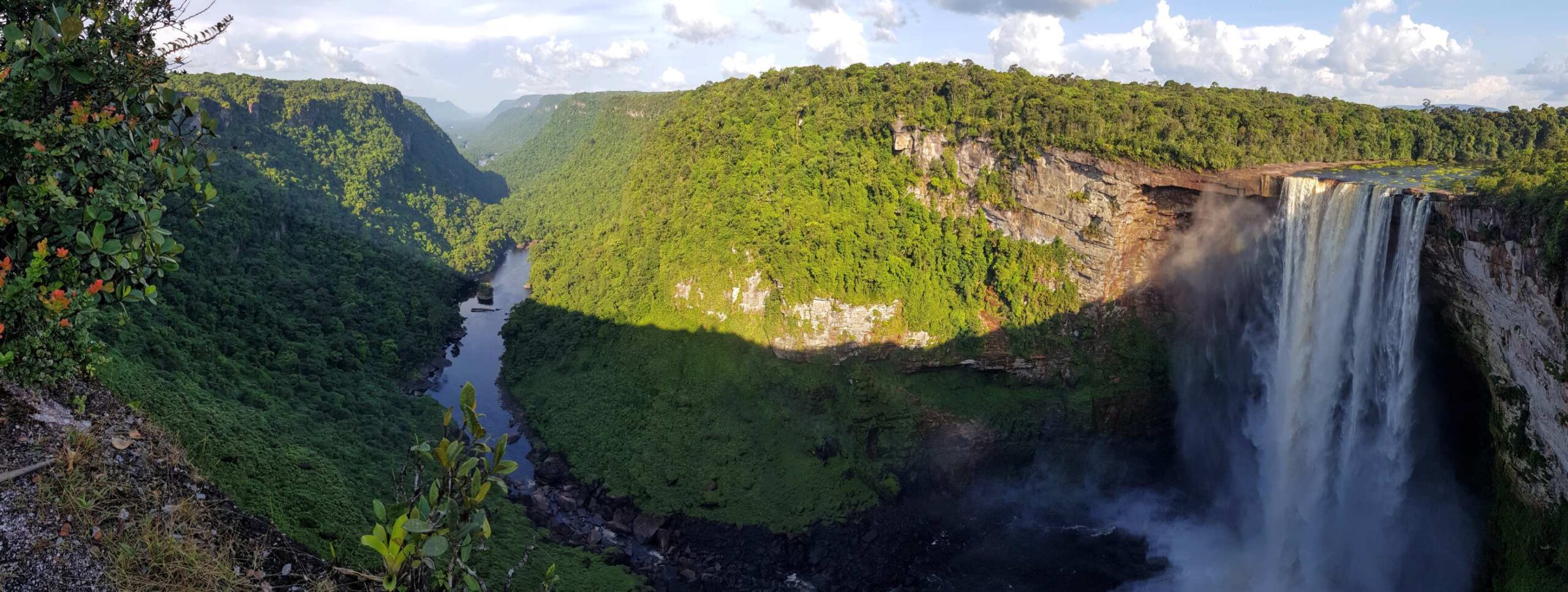
There are no other falls in the world with the magnitude of the sheer drop at Kaieteur. The Potaro river flows over a sandstone conglomerate tableland into a deep gorge - a drop of 251 meters (822 feet) or 5 times the height of Niagara Falls. Kaieteur supports a unique micro environment with Tank Bromeliads, the largest in the world, in which the tiny Golden frog spends its entire life. The Guianan Cock- of-the-rock nests close by, and a lucky visitor may also see the famous flights of Makonaima Birds which nest behind the eternal curtain of falling water.

Unparalleled and remarkable biodiversity
Meet some of the endangered giants of South America, many of which are still thriving in Guyana: jaguar, giant river otter, giant anteater, giant armadillo, capybara, harpy eagle, arapaima, a water lily big enough to support a child, black and spectacled caiman, giant river turtle, false vampire bat, the bushmaster pit viper, green anaconda, and a bird-eating spider. Expert indigenous guides will ensure that your encounters with these magnificent creatures are as close up — or as safely distant — as possible. (more)

Amerindian heritage
For thousands of years the Guianan Shield has been home to a dynamic mix of Amerindian and immigrant populations: indigenous Akawaio, Arekuna, Carib, Macushi, Patamona, Waiwai, and Wapishana tribes have been joined in the last century by European colonialists, west African slaves, and indentured servants from Java and India. As a result, intrepid travellers who venture to the Guianas discover a cultural experience remarkably unlike any other in South America.

Vast pristine rainforests
Guyana may be the third-smallest country in South America, but its tropical forests are an important resource for the whole world. With nearly 80 percent of its land covered by rain forest, Guyana joins neighbors Suriname, French Guiana and portions of Venezuela and northern Brazil to form the Guayana Shield region of Amazon forest—the source of 20 percent of the world’s fresh water. The vast forests of the Guayana Shield also contain 18 percent of all the carbon dioxide stored in the world’s tropical forests. (more)

Community tourism projects
Three Macushi villages have opened rainforest eco-lodges entirely owned and operated by the local community. Other communities support the eco-lodges by providing food, supplies, and services. These lodges are cooperatively managed and staffed by villagers who take time out of their normal daily routines to provide services to guests. You will be treated to authentic Makushi hospitality as if you were a guest in one of their homes. (more)


Getting to Guyana from Europe
Many travellers find the best connections are through New York's JFK where both Delta Airlines and Caribbean Airlines offer direct service into Georgetown. Some prefer to fly into Bridgetown, Barbados and connect to daily LIAT or service into Georgetown. RedJet is a new carrier beginning to offer service into Guyana.

Getting to Guyana from North America
Caribbean Airlines runs flights into Guyana's Chedi Jagan International Airport (CJIA) from Toronto, New York JFK, and Miami, connecting in Port of Spain, Trinidad and Tobago. Delta offers non-stop service out of JFK. Travellers coming from the US west coast are usually able to connect to the last flight of the day out of Miami for a same-day arrival in Guyana.

Getting around Guyana
Transport into Guyana’s largely unpopulated interior regions is by small plane, river canoe, 4X4 pickup truck, and the occasional bullock cart. Indeed, getting around is truly part of the adventure!

Outside of Georgetown, there are few roads (none of which are paved) and the small number of vehicles that ply the rugged dirt and laterite roads are, frankly, miracles of endurance and roadside maintenance. Luxury aircon Land Rovers are unheard of, as are roadside petrol stations and convenience stores. That said, the vehicles and drivers we hire are a solid and reliable lot and you can be assured that you'll get where you're going. Usually on schedule!

Guyana's real highways are its rivers, and you are likely to spend at least a day or two meandering along the Burro Burro, Rupununi, Rewa, Demerara, or Essequibo Rivers during your visit. Boats are typically open to the elements and run by a small outboard motor. The best bird spotting and wildlife viewing comes from these sinuous waterways, so be sure to come with a hat, sunscreen, binoculars, and a good camera. All boats have both a captain and spotter (to avoid snags and sandbars) and are equipped with life vests, water, and tarpaulins.

Aircraft are small but well-maintained bush aircraft with 6-12 seats: Cessna Caravans, 206's, and Norman Islanders... you might even get to sit up front with the pilot! No need to remove your shoes and you surely won't get scatter-scanned out on a dirt airstrip miles from civilization.

Rainforest and savannah lodges
Guyana has only a handful of lodges in its rainforests and savannahs, and most of these are small and remote establishments with fewer than a dozen beds. Some - like Rewa, Surama, and Maipaima - are run by the local Amerindian villagers who turn your visit into something like a homestay experience. Others - like Karanambu and Rock View Lodge - are captained by British expats who have carved out a slice of unexpected comfort in an otherwise rugged environment. Others yet - such as Caiman House, Atta Rainforest Lodge, and Iwokrama River Lodge - have a strong science and nature focus and provide amply comfortable hospitality as well as a chance to learn about the vivid surrounding ecosystems. Running water and at least a few hours of electricity are available at each lodge, and amenities are always clean and comfortable.

While no one comes to Guyana looking for a luxury travel experience, welcome creature comforts are on offer at the charming colonial boutique Cara Lodge in Georgetown as well as the storied Pegasus on the city's northwest corner. Meanwhile, Baganara Island on the Essequibo delights visitors with a host of recreational and relaxation opportunities.

Community tourism in Guyana
The CATS Community Tourism Partnership operates the Iwokrama Canopy Walkway and Atta Rainforest Lodge, a joint partnership between Wilderness Explorers, Surama Village, Iwokrama River Lodge, and Rock View Lodge. Several Amerindian communities run their own eco-lodges including Surama, Rewa, and Maipiama Eco-Lodges. A stay in Guyana isn't complete without at least a night or two at one of these Amerindian eco-lodges.

Learn more about Guyana's hotels & lodges
Click here to see a full rundown of lodges, or click the individual properties below.


Flights in Guyana are aboard small propeller-driven craft such as this Cessna Caravan


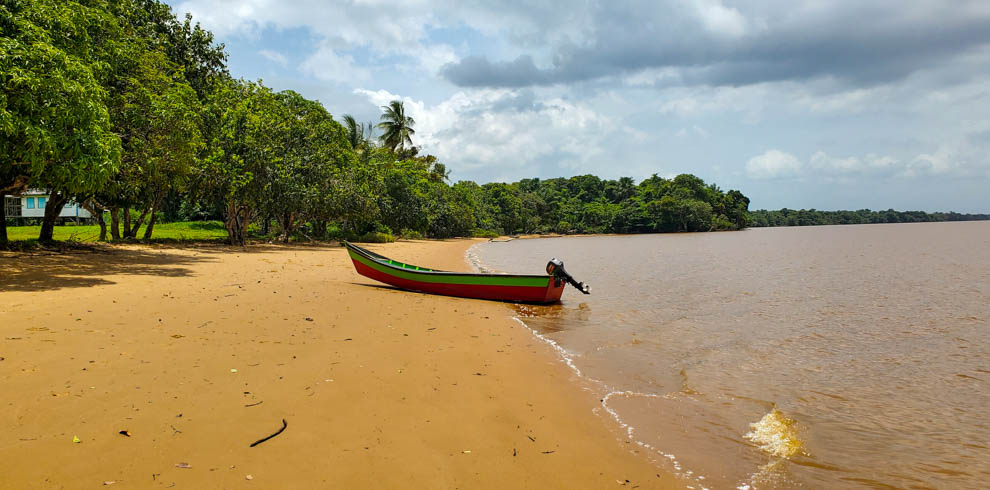
Small boats and canoes are essential tools for transport and wildlife spotting


Sometimes there's nothing that will get you through except a rugged and reliable 4X4


Traditional architecture at Surama Eco-Lodge in the Pakaraima Mountains


Charming colonial architecture at Cara Lodge in Georgetown


bullet
Are your itineraries online?
Yes! Check our Itineraries page to see them all.


bullet
Do I need a visa to visit?
All visitors require a valid passport. The following countries do not need a visa: Commonwealth countries, Belgium, Denmark, Finland, France, Germany, Greece, Ireland, Italy, Japan, Korea, Luxembourg, Netherlands, Norway, Portugal, Spain, Sweden, Switzerland and the USA. Keep in mind that all of Guyana's neighbors - Venezuela, Brazil, and Suriname - require visas for most visitors. Those arriving by plane are required to have an onward plane ticket or documented travel arrangements. Current visa requirements should be verified as requirements can change at any time. (more)


bullet
Do I need to get shots or take malaria pills
Please consult your local travel clinic as well as the Centers for Disease Control website. These are the tropics, and insect bites are an inevitability. In addition to prophylactic measures, we always recommend long sleeves, various natural and man-made repellents, and good sense. (more)


bullet
Can I do the Canopy Walkway in a day visit from Georgetown?
No. To reach the Iwokrama rain forest you would take the overnight IntraServ bus or hop on the once-daily TransGuyana Airways flight to Annai. Fortunately, the Atta Rainforest Lodge at the base of the Canopy Walkway is a comfortable and secluded rainforest lodge, perfect for overnighting during your stay. Groups interested in charter flight arrangements can fly into either Annai or Fair View, making a stop at Kaieteur Falls along the way.


bullet
What's the best time of year to visit?
You're coming to the tropics, so plan on getting wet no matter what time of year you visit! You'll experience relatively fewer weather-related inconveniences between September and May, but the so-called wetter months have their own benefits: cooler temperatures, easier river transport, different birds, etc. None of the roads in Guyana's interior are paved, so muddy conditions can impact your ground travel plans.


bullet
Why is Guyana so expensive?
Many travellers are surprised to learn that Guyana is one of South America's most expensive destinations (exceeded, perhaps, only by French Guiana to the east). Unlike better-known, well-touristed rainforest destinations around the world, Guyana hosts only a few thousand visitors per year, leaving no opportunity to develop economies of scale in the tourism sector. Lodges are extremely remote, roads are few, vehicles are fewer, and everything operates at a small, local scale... all adding to the difficulty and cost to run excursions here. In return for the comparatively high cost, however, visitors get a stunningly rare glimpse into a primitive world that hasn't been overrun by the masses.


bullet
Is Guyana safe?
Georgetown's reputation for crime is associated with ups and downs in the local drug trade, none of which is likely to intersect with tourist activities or destinations. The biggest safety concern in Guyana comes from the remote and wild places you will visit: acess to western-standard medical care may take hours or days over trails, rivers, and rutted dirt roads. All travellers in Guyana should carry a good first aid kit and all the medical supplies they require.


bullet
I'm a birder - do you have lists I can work with?
Quite a few resources are offered on the Checklist page of this website. Wilderness Explorers guests have access to additional resources once they arrive in country.


bullet
I'm not a birder - is there anything for me in Guyana?
Absolutely! For many years, Guyana has sold itself as a birder's paradise, but the secret is out that Guyana has plenty to offer naturalists and adventure travelers of all stripes. You can certainly look forward to meeting at least one or two of the ‘giants’ of Guyana, including the world’s largest otter (Pteronura brasiliensis), largest anteater (Myrmecophaga tridactyl a), largest bat (Vampyrum spectrum) largest pit viper (Lachesis mutt, or ‘bushmaster’), largest freshwater turtle (Podocnemis expanse) largest freshwater fish (Arapaima gigs), largest spider (Theraphosa blondi, commonly known as the bird-eating spider), largest bird of prey (Harpia harpy, or harpy eagle) largest rodent (Hydrochaeris hydrochaeri) or the endangered black caiman (Melanosuchus niger). You’ll even view the world’s largest water lilly (Victoria amazonica) and possibly get to watch one of its blossoms make a rare twilight bloom. And don’t worry – your expert guides will ensure that your encounters with these giants are from a respectable and safe distance.

More of a culture hound? Guyana is one of the few places on earth where you can comfortably carry on a conversation with indigenous people in your/their native english. This presents wonderful opportunities to develop camraderie and understanding without the hassle of a translator. If you come to Guyana in September, ask about the schedule for the Rupununi's annual Heritage Festival.

Then there's simply the adventure of moving around in Guyana in small planes, canoes, 4X4 jeeps, and along its remote jungle trails. There's no such thing as a boring day in the wild rainforests and savannahs of Guyana.


bullet
Do you have reading lists, packing suggestions, and other trip perparation materials for me to read?
Yes! All our clients are provided with pre trip materials assembled by our field staff to help you prepare for your trip. The best place to start is the Bradt Guide to Guyana by Kirk Smock (look in our US and UK store). It's the only dedicated guide to the country written by a venerable traveller who really knows the country's ins and outs. A new version was published in mid-2011.


bullet
Whoa - Guyana sounds pretty wild!
Guyana remains an unknown destination for most people. Travel writer John Gimlette says, “You couldn’t invent a place like this... if it were a novel, it would be rejected as utterly improbable.” (His book, The Wild Coast, is a great read).

This is a nation at the earliest stages of developing a viable tourism industry, with infrastructure and expertise evolving steadily but inconsistently. The Guyanese people are pursuing sustainable and community-based approaches to tourism which means your experience will be genuine, authentic, and intimate. We think this goes to the heart of Guyana's treasure: unspoiled nature, inquisitive locals, non-commoditized opportunities for adventure. This rawness is, however, delicate and somewhat unpredictable. As you travel through this fascinating territory, we must stress the importance of adopting a sensitive, responsible, and patient attitude. This is especially true for the first two or three days of your trip while your mind’s clock will be adjusting to the local rhythms.

Despite our best endeavors, local flight delays and rescheduling may occur at short notice. Vehicles may break down, fail to appear, or get stuck in a muddy rut. You might find yourself scanning a river on the one day every single giant river otter has gone a different direction. You might awake one morning to find a (harmless) fruit bat staring at you through your mosquito net. In all this, your positive frame of mind and sense of humor will help enormously!


©2013 Wilderness Explorers - Guyana, South America
Guyana [+592] 227-7698 | London [+44] 020 8417 1585 | Europe [+41] 56 222 9978 | US [+1] 202-630-7698
24-Hour Emergency Contact in Guyana: [+592] 624-2225
journeys@wilderness-explorers.com
Client Login | Agent Login